When Silent Films Learned to Put Words on Screen
Learn when silent-film intertitles appeared and how their timing, wording, and design turned written cards into active parts of screen storytelling.
The common mistake with silent-film intertitles is to treat every card as dialogue paused for reading. That misses both their early history and their range: written cards entered film storytelling in the silent era’s earliest years, then became flexible tools for dialogue, explanation, suspense, and comedy. Their arrival was not a single invention with one date; filmmakers adapted printed words to the moving picture as exhibition practices and storytelling conventions took shape.
Intertitles emerged as films began telling longer stories
Early films often presented brief scenes or attractions that needed little written explanation. As filmmakers began joining shots into longer narratives, audiences sometimes needed help identifying a place, understanding a jump in time, or following an exchange whose meaning was not clear from action alone. Written cards offered a direct way to supply that information within a screening.
The practice developed gradually in the 1900s. Early explanatory cards could appear before a scene or be incorporated into the image; later, separate title cards became a familiar way to insert dialogue and narrative information between shots. By the 1910s, intertitles were an established part of many narrative films, though conventions differed by film, country, and production.
So the answer to “when did silent films start using intertitles?” is not a tidy year. The useful distinction is between early, occasional written explanations and the more systematic use of separate cards as films grew more elaborate. Intertitles were part of silent cinema’s evolving toolkit, not a device that arrived fully formed.
Cards changed what filmmakers could ask an image to do
A card could identify a location, supply a character’s words, or reveal the contents of a letter. Just as importantly, it could withhold information. A film might show someone discover a note, let the audience read it, then cut to a reaction. That sequence gives the written message its own dramatic moment instead of treating it as background explanation.
Intertitles also let filmmakers compress conversation. A scene did not need to print every imagined sentence; it could present the line that changed a relationship or moved the plot. The performer’s posture, expression, and gesture carried the rest. A card and an actor could therefore share the work of a scene rather than compete to explain it.
Different jobs often meet in one card. A message may establish a plan and reveal the sender’s character at once; a short reply may deliver information while making a joke land. It is more useful to ask what the card contributes than to force it into a single category.
Watch the order of cards and action
Placement gives an intertitle much of its force. A card before a character opens a letter can create anticipation; the same words after the letter is opened can confirm what the audience has just learned. A card between two gestures may make the second gesture look like a decision, while a card after it can recast that action as a response.
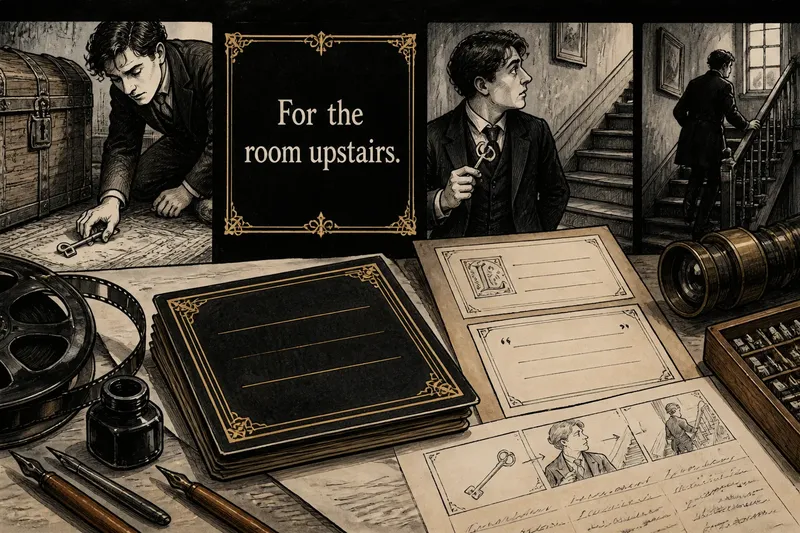
Imagine a character finding a key beside a locked box. The film cuts to a card reading “For the room upstairs,” then shows the character glance toward the staircase. The words turn the key from an unexplained object into a destination, and the glance becomes a choice. If the same card appeared after the character climbed the stairs, it would explain the journey rather than prompt it.
Reading time matters, too. A brief card inside brisk action can feel like a beat in the scene; a longer passage can ask viewers to pause and absorb detail. Different prints, restorations, translations, and playback conditions may affect the apparent rhythm, so avoid treating one presentation as the definitive timing of every screening.
Separate a character’s words from the film’s other writing
Dialogue cards present speech, but silent films also use cards for narration, scene-setting, and documents inside the story. A letter shown as a card may belong to a character, while an explanatory title may speak from outside the scene. Context, typography, and the images around the words can help distinguish these voices.
When a card gives dialogue, compare it with the performance that follows. A character may appear doubtful after a confident line, or answer with a gesture rather than another card. The written words provide a verbal clue, but expression and movement can complicate their meaning. Treating every dialogue card as a complete transcript makes the scene feel flatter than it is.
Intertitles carry visual style as well as words
Lettering, spacing, ornament, and contrast turn each card into a designed image. A film may distinguish a letter from spoken dialogue or give a narrator’s words a different visual treatment. These choices help establish tone and guide the viewer’s attention, much as costumes and sets do within the moving scenes.
Surviving editions may handle original cards differently. A release might preserve an original-language title, replace it with a translated card, or add subtitles over the image. Each choice can change the appearance and reading rhythm. If the design matters to your interpretation, check the edition’s presentation rather than assuming every copy shows the same card.
What do viewers ask about silent-film intertitles?
When did silent films begin using intertitles?
Written explanations appeared in cinema’s early years, and separate title cards became more established as narrative films grew longer and more complex. There is no single start date that covers every film tradition or exhibition practice.
What is the difference between an intertitle and a subtitle?
An intertitle is typically a separate card inserted between shots, while a subtitle appears over an image. Restored editions can blur the distinction when translations are added to or substituted for original cards.
Why did silent films use dialogue cards?
Dialogue cards conveyed speech that filmmakers wanted viewers to know precisely, while leaving performers’ gestures and expressions to carry other parts of the exchange. A card could also shape timing by making a line arrive before or after a reaction.
Did every silent film use intertitles?
No. The amount and kind of written material varied with the film, its storytelling needs, and the conventions of its production and exhibition. Some scenes relied heavily on visual action, while others used cards to clarify important information.
Read a sequence without turning it into a puzzle
For a short passage, note the image before each card, what the words contribute, and what changes afterward. Keep the notes focused on the sequence rather than searching for a hidden meaning in every phrase. The point is to see how the filmmakers divided storytelling between printed words, performance, and moving images.
- Check the preceding shot: If it already explains the card’s basic fact, then consider emphasis or irony; otherwise, treat the card as supplying new information.
- Check whether the card names a time or place: If the next shot confirms a shift, then read it as orientation; if not, look for another function such as mood or emphasis.
- Check for a visible document or sign: If the card gives its contents, then connect the words to that object; otherwise, consider whether the text comes from a character or narrator.
- Check the gesture after dialogue: If it supports the line, then read the performance as agreement; if it contradicts the words, consider irony, doubt, or concealment.
- Check where the card falls in an action: If it comes before a choice, then it may prepare or provoke that choice; if it follows, consider whether it explains or reinterprets what happened.
- Check the card’s visual treatment: If its lettering or layout differs from nearby cards, then consider a change of voice or document type; if it matches, use the surrounding scene to identify the speaker.
- Check the edition’s translation method: If a translated card replaces the original, then avoid drawing conclusions from its design; if subtitles preserve the original card, consider both layers when judging reading rhythm.
Say you are watching an invented scene in which a visitor arrives at a house. First, you note the exterior shot; then a card identifies the hour; next, a close view shows a calling card; finally, the host reacts with alarm. You decide the hour supplies urgency because it adds information not visible in the exterior, and the calling card identifies the visitor because it appears immediately before the host recognizes the name. The sequence leaves one tradeoff: the reaction might communicate the visitor’s importance without the card, but the written name gives the audience a clue the performance alone may not provide.
Keep the historical point in view when you watch silent-film intertitles: they were not merely substitutes for recorded speech. They grew into a screen language that could direct attention, control a reveal, and let a still card participate in the film’s visual storytelling.